
 Jyoti Sharma
December 18, 2025
Jyoti Sharma
December 18, 2025
In agriculture, informed decisions begin beneath the surface. Understanding soil health is fundamental to crop productivity, fertiliser efficiency, and long-term farm sustainability. For decades, soil testing has helped farmers analyse nutrient levels and soil composition. However, with the rise of artificial intelligence (AI), a new generation of data-driven tools is redefining how soil is assessed. This raises an important question: how does AI-based soil analysis compare with traditional soil testing methods in terms of accuracy?
What is traditional soil testing?
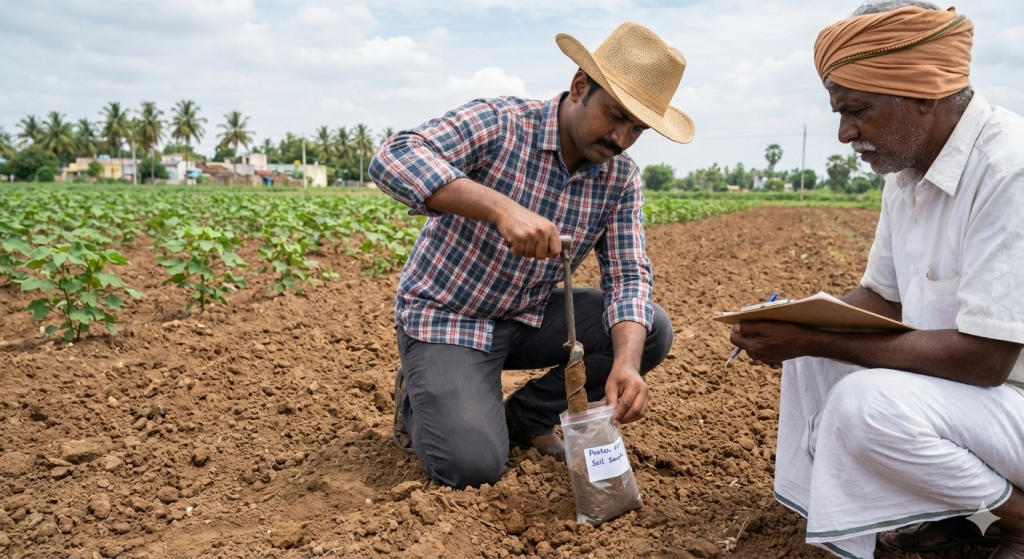
Traditional soil testing involves collecting soil samples from predetermined spots across a field, which are then analysed in certified laboratories. These tests typically assess key parameters like nitrogen, phosphorus, potassium, pH, organic carbon, and micronutrients. For instance, India’s Soil Health Card (SHC) Scheme, one of the largest soil-testing initiatives globally, has issued over 250 million Soil Health Cards by analysing soil samples from farms across the country.
The SHC programme operates through a network of more than 8,200 soil testing laboratories (including static, mobile, mini and village-level labs), enabling extensive coverage. These results help farmers make informed decisions about fertiliser use and crop planning, and provide a scientific basis for nutrient management.
Despite its widespread use and scientific rigour, traditional soil testing has limitations. Lab turnaround times can take days or weeks, and test results are essentially point estimates, meaning the insights apply only to the specific locations sampled, not the entire field. This can be especially limiting for large farms with highly variable soil conditions.
AI-powered soil testing: What’s different?
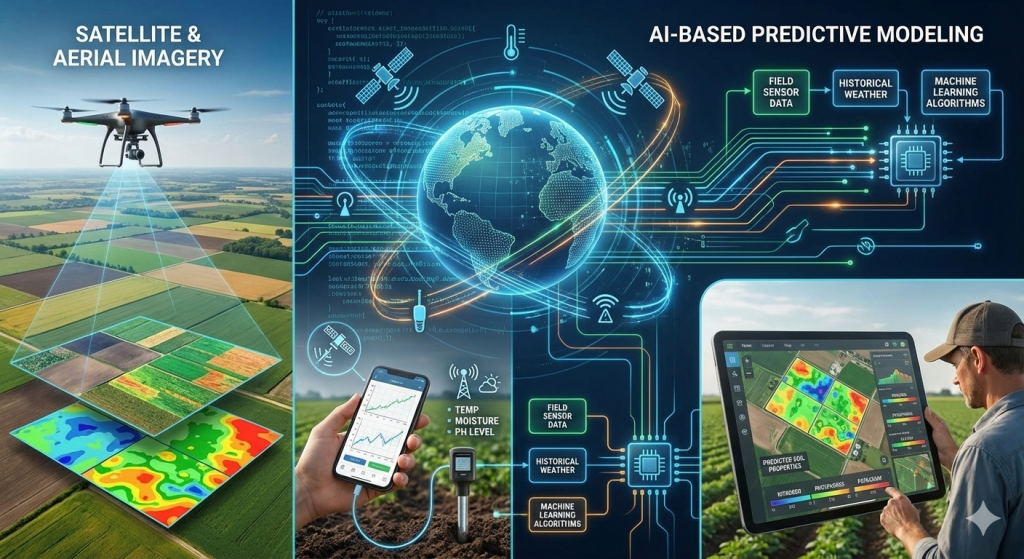
AI-based soil testing uses advanced algorithms, machine learning, sensor data, satellite imagery and field analytics to model soil properties at scale. Instead of analysing only a handful of physical soil samples, AI systems ingest multiple data streams, from aerial imagery to historical weather patterns, to predict soil attributes across entire farm landscapes.
Industry research shows that AI integration in agriculture can boost accuracy and resource efficiency. AI-powered soil sensors and digital tools can improve nutrient application planning, increasing fertiliser efficiency by up to 30%, compared with non-automated approaches. These systems also support real-time monitoring, enabling farmers to adjust inputs dynamically rather than waiting for lab reports.
Farms using AI-led precision farming techniques report yield increases of 15–20% while reducing costs by an average of 15–20%, according to industry estimates. Although not all these figures relate solely to soil testing, they illustrate the performance uplift AI can bring when integrated into farm decision systems.
Accuracy: Lab precision vs data intelligence
- Traditional soil testing remains the gold standard for chemical precision. Laboratory tests were designed specifically to quantify nutrients and other soil attributes with high accuracy and regulatory compliance. If a farmer needs to know the exact amount of nitrogen or micronutrient deficiency, nothing currently beats a certified lab’s chemical analysis.
However, in practical use, traditional methods often fall short of capturing variation across large or heterogeneous fields. One soil test might represent just a small patch of land, leading to misleading recommendations when extrapolated to the whole farm. This is especially problematic for precision agriculture, where site-specific management is critical. - AI-based soil testing excels in capturing spatial variability. By combining multispectral satellite data, sensor networks and machine learning, AI systems can map soil characteristics with impressive resolution. Models can identify “micro-zones” within fields that require distinct fertiliser rates, irrigation scheduling, or crop varieties. While AI models depend on strong datasets and sometimes require initial baseline lab tests to calibrate predictions, they often reveal patterns that a few point samples simply cannot capture.
Speed, scalability & decision making
One strong advantage of AI over traditional testing is speed. In the traditional workflow, soil samples must be physically collected, couriered to labs, analysed, and reported, a process that spans days or weeks. With AI-enhanced diagnostics and digital decision systems, farmers can receive actionable insight within hours or even minutes, enabling quicker responses to crop needs.
When it comes to scalability, AI-based soil analysis scales effortlessly. It processes thousands of data points across extensive farms in a fraction of the time it would take to manually sample broad acreage. For agribusinesses managing multiple estates, this capability turns soil testing from an occasional ritual into a dynamic, ongoing component of farm management.
Cost & accessibility
- Traditional soil testing involves recurring costs: sample collection, transportation, and lab fees. While prices are generally affordable, multiple tests over different seasons and sites add up, and farmers in remote regions may struggle with logistics.
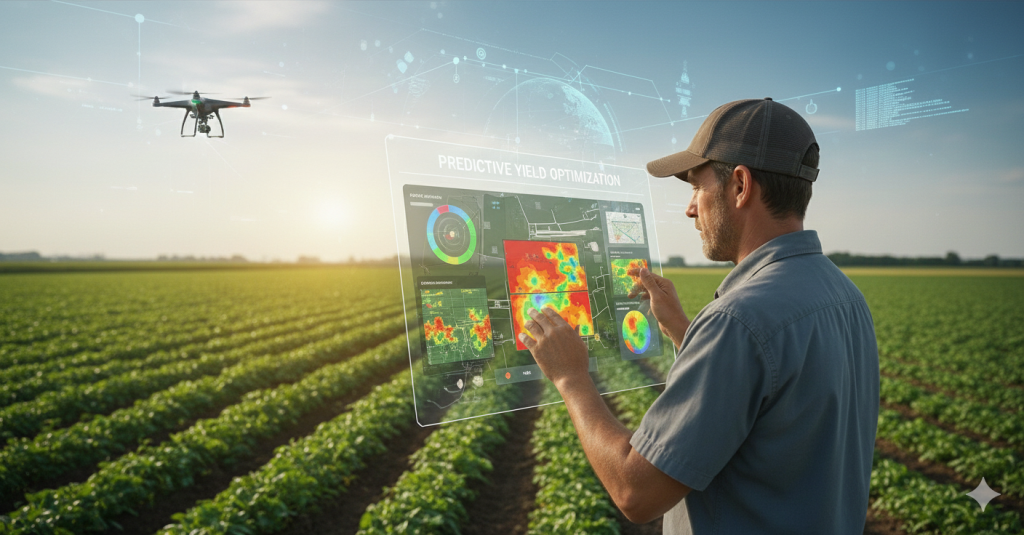
- AI systems often require initial investment in data infrastructure, sensors and software, but the marginal cost per additional analysis is comparatively low once the platform is established. Hybrid approaches that use periodic lab tests to calibrate AI models are emerging as cost-effective ways to achieve both precision and depth.
agribazaar supports soil testing
Recognising the importance of soil intelligence in modern agriculture, agribazaar also offers soil testing services as part of its broader agri-ecosystem. These services help farmers and agri-businesses access reliable soil health insights that support informed crop planning and nutrient management. By integrating on-ground soil analysis with digital platforms, agribazaar enables data-backed decision-making aligned with precision agriculture practices.
Conclusion: Complementary, not exclusive
So, which approach delivers more accurate results? Traditional soil testing provides unmatched chemical precision, while AI-based soil testing delivers superior spatial coverage, speed and adaptability. Rather than competing, the two approaches complement each other.
The future of soil assessment lies in integration, using lab-based soil testing as a scientific foundation and AI-driven tools to scale insights, monitor variability and improve decision-making. With platforms like agribazaar supporting soil testing alongside digital agri-services, farmers and agri-businesses can move toward smarter, more efficient and sustainable farming systems grounded in data-driven soil intelligence.
Disclaimer
The content published on this blog is provided solely for informational and educational purposes and is not intended as professional or legal advice. While we strive to ensure the accuracy and reliability of the information presented, agribazaar make no representations or warranties of any kind, express or implied, about the completeness, accuracy, suitability, or availability with respect to the blog content or the information, products, services, or related graphics contained in the blog for any purpose. Any reliance you place on such information is therefore strictly at your own risk. Readers are encouraged to consult qualified agricultural experts, agronomists, or relevant professionals before making any decisions based on the information provided herein. agribazaar, its authors, contributors, and affiliates shall not be held liable for any loss or damage, including without limitation, indirect or consequential loss or damage, or any loss or damage whatsoever arising from reliance on information contained in this blog. Through this blog, you may be able to link to other websites that are not under the control of agribazaar. We have no control over the nature, content, and availability of those sites and inclusion of any links does not necessarily imply a recommendation or endorsement of the views expressed within them. We reserve the right to modify, update, or remove blog content at any time without prior notice.