 Jyoti Sharma
June 3, 2026
Jyoti Sharma
June 3, 2026
There was a time when digitising agricultural trade itself felt revolutionary.
Getting mandi prices online was a big step. Connecting buyers and sellers through a platform changed how agricultural markets function. Digital payments, transparent pricing, and online trading began creating a more connected agricultural economy.
But agriculture is now entering its next phase. And interestingly, the next disruption may not come from simply putting markets online. It may come from making them intelligent.
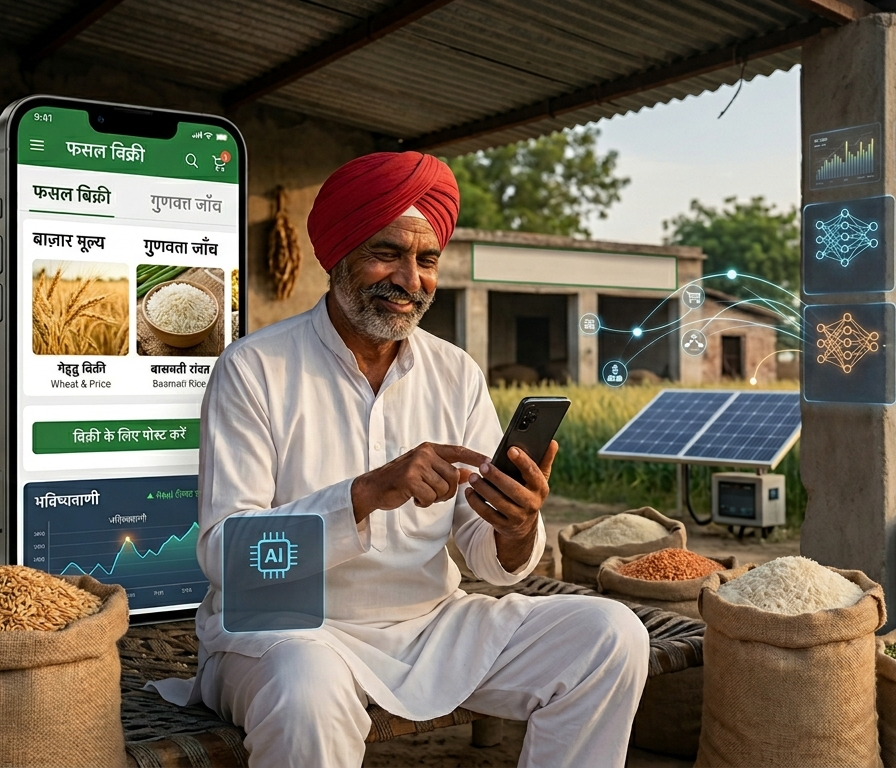
Imagine a mandi that doesn’t just display prices, but helps anticipate demand shifts before they happen. A platform that not only connects traders but also helps identify procurement opportunities, weather-linked risks, or possible supply shortages in advance.
That’s the direction agricultural trade is slowly moving toward: from digital mandi to AI mandi.
And in a country like India, where agriculture still operates across fragmented supply chains and information gaps, this shift could become far more important than we realise.
India recorded foodgrain production of nearly 357 million tonnes in 2024–25, one of its highest ever. At the same time, digital agricultural marketplaces are scaling rapidly. The e-NAM platform today connects 1,656 mandis and more than 1.8 crore farmers across India.
Yet despite this growth, one challenge persists across the agricultural value chain: visibility.
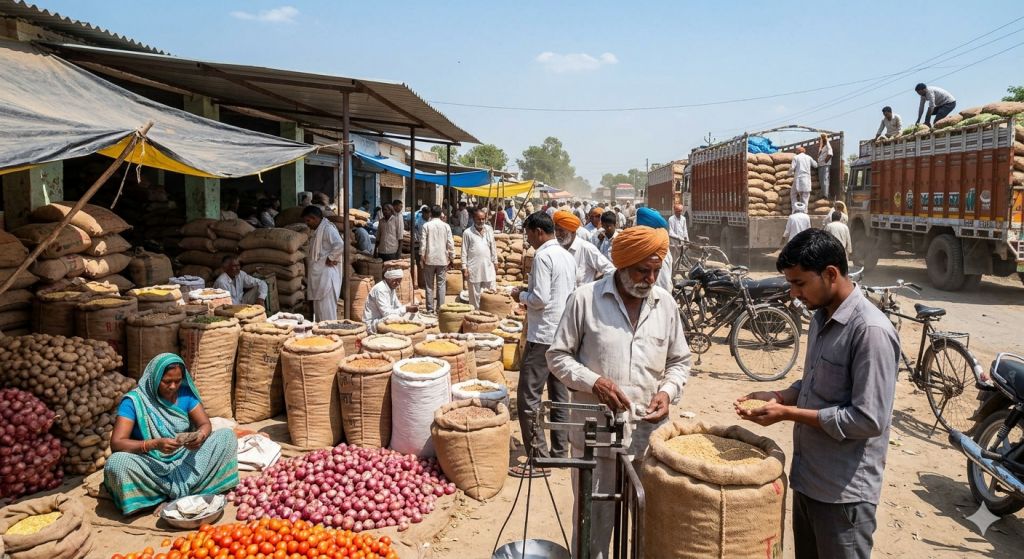
Most agricultural markets still react to information rather than predict it.
Farmers often sell without knowing future demand trends. Buyers struggle to estimate arrivals accurately. Traders depend heavily on fragmented market signals. Supply chains remain reactive instead of predictive. And this is exactly where AI-led intelligence layers are beginning to reshape agriculture globally.
Agriculture is becoming a Data Ecosystem
For decades, agricultural trade relied heavily on physical indicators like mandi arrivals, trader networks, seasonal estimates, and ground-level experience. Those factors still matter. But now, they are being supported by something much bigger: data intelligence.
Today, satellite imagery can detect crop stress before harvest. Weather models can indicate production risks weeks in advance. AI systems can analyse pricing behaviour and commodity movement patterns in real time.
Agriculture is no longer operating only through physical movement. It’s increasingly operating through the movement of information.
India’s agritech ecosystem now includes more than a thousand startups, with rising investments flowing into AI-driven supply chains, predictive agriculture, satellite intelligence, and digital agri-finance platforms.
What’s particularly interesting is that AI in agriculture is moving beyond farm advisory. It is now influencing:
- procurement planning,
- inventory movement,
- commodity intelligence,
- storage decisions,
- risk assessment,
- and agri-finance.
In many ways, agriculture is slowly becoming a connected intelligence network instead of just a fragmented supply chain.
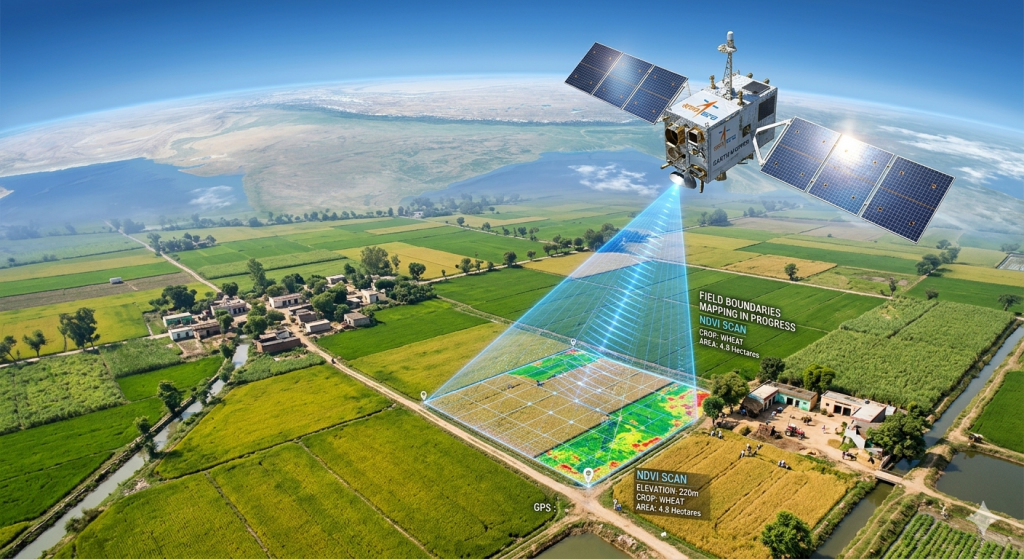
So what exactly is an “AI Mandi”?
An AI mandi is not just a digital marketplace with automation. It is an ecosystem where multiple intelligence layers work together continuously. Think about the amount of agricultural data being generated today:
- satellite imagery,
- weather updates,
- mandi arrivals,
- crop health observations,
- logistics movement,
- procurement behaviour,
- warehouse stock positions,
- and farmer transaction patterns.
Individually, these are just data points. But when connected intelligently, they begin creating predictive agricultural ecosystems. For example:
- Weather anomalies could indicate lower arrivals weeks later.
- Crop health data could help buyers plan sourcing strategies early.
- Procurement patterns could indicate potential price movements.
- Logistics disruptions could signal supply-chain bottlenecks before markets react.
This is where the future of agricultural commerce becomes extremely interesting. Because the next generation of agri platforms may not compete only on transactions, they may compete on intelligence.
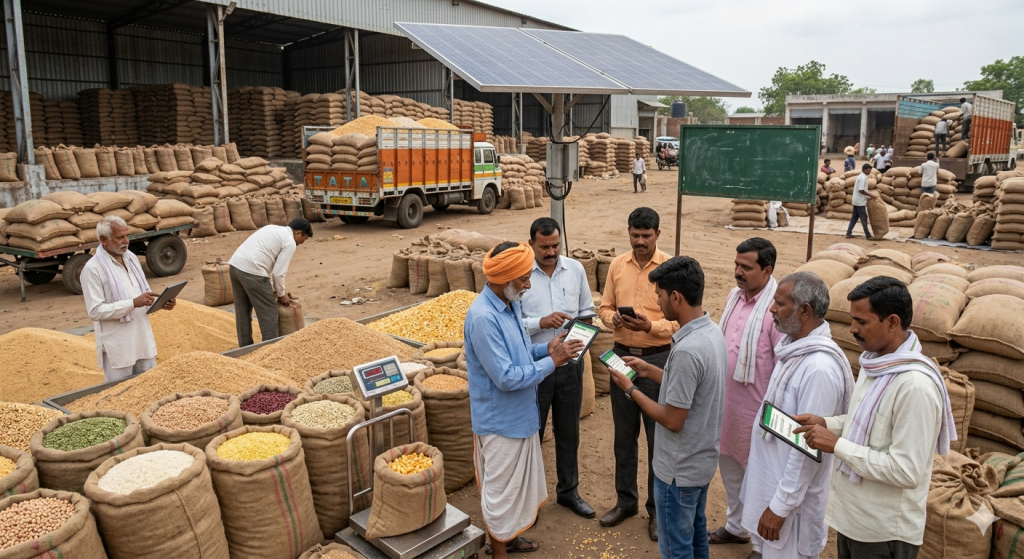
The future of agricultural trade may be Predictive
Agriculture has traditionally been reactive. Prices moved after arrivals increased. Supply concerns emerged after weather disruptions occurred. Procurement planning happened after markets shifted.
But AI is beginning to change that sequence.
The industry is slowly moving toward predictive agriculture, where decisions can potentially happen before disruptions fully unfold. That could reshape:
- procurement efficiency,
- financing decisions,
- inventory management,
- storage planning,
- and commodity movement.
This is where integrated agritech ecosystems are likely to play a larger role in the future. agribazaar is already moving in this direction by combining digital commodity trading with market intelligence, weather insights, farmer advisory, and satellite-backed land intelligence through Agribhumi.
Today, agribazaar works across more than 100 commodities and connects over 3 lakh farmers and traders across India, while Agribhumi has geo-tagged more than 4 lakh farms across multiple states.
And perhaps that’s what the idea of an AI mandi truly represents. Not replacing traditional agricultural markets, but making them smarter, faster, more connected, and far more informed than before.
Disclaimer
The content published on this blog is provided solely for informational and educational purposes and is not intended as professional or legal advice. While we strive to ensure the accuracy and reliability of the information presented, agribazaar make no representations or warranties of any kind, express or implied, about the completeness, accuracy, suitability, or availability with respect to the blog content or the information, products, services, or related graphics contained in the blog for any purpose. Any reliance you place on such information is therefore strictly at your own risk. Readers are encouraged to consult qualified agricultural experts, agronomists, or relevant professionals before making any decisions based on the information provided herein. agribazaar, its authors, contributors, and affiliates shall not be held liable for any loss or damage, including without limitation, indirect or consequential loss or damage, or any loss or damage whatsoever arising from reliance on information contained in this blog. Through this blog, you may be able to link to other websites that are not under the control of agribazaar. We have no control over the nature, content, and availability of those sites and inclusion of any links does not necessarily imply a recommendation or endorsement of the views expressed within them. We reserve the right to modify, update, or remove blog content at any time without prior notice.