
 agribazaar
July 7, 2019
agribazaar
July 7, 2019
Sowing period: October to December
Harvesting period: January to April
Crop season: Rabi
Key growing regions:
- Madhya Pradesh – Neemuch, Mandsaur, Guna, Rajgarh, Shajapur
- Gujarat – Rajkot, Surendranagar, Gondal, Junagarh, Jamnagar
- Maharashtra – Mumbai, Nanded, Bhandara
- Rajasthan – Ramganj, Kota, Jhalawar, Baran, Bundi
Production trend and Stock position:
- Area sown until February 27, 2019 was 1,866 hectares down by 72.78 percent in Andhra Pradesh for this Rabi season compared to 1,080 hectares in the corresponding period last year.
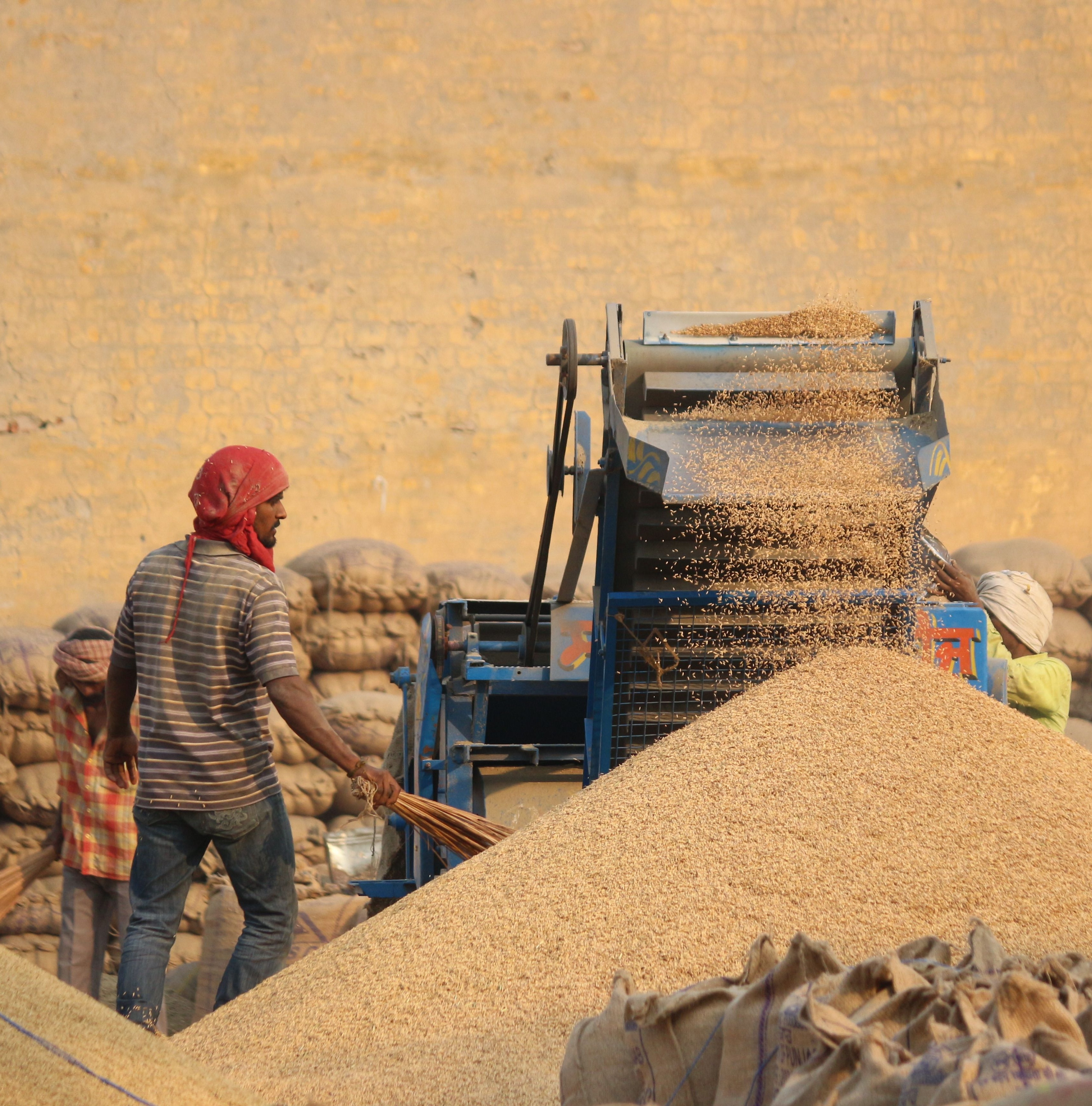
- There is an expectation of a decline in production of coriander seeds this year as harvest is nearing its final stages in most chief producing states of Madhya Pradesh, Rajasthan and Gujarat.
- As per Agriwatch website, the crop in Gujarat is expected to be less this year due to insufficient rain which forced many farmers to shift to other lucrative crops.
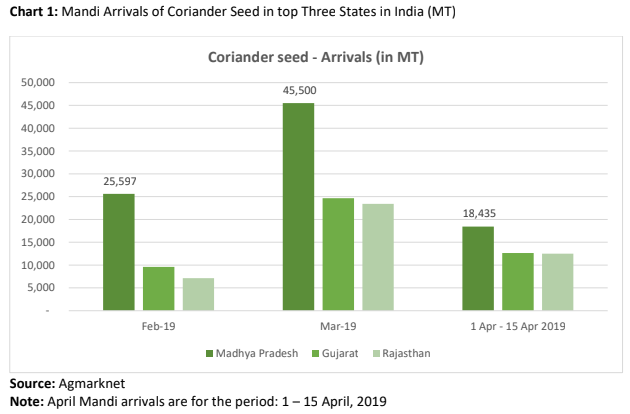
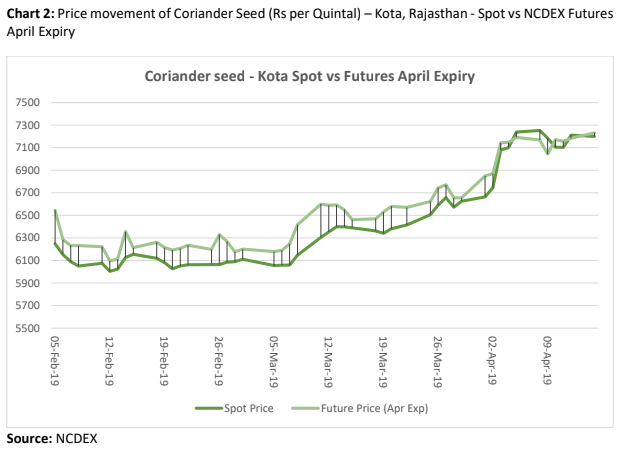
Note: Prices of Coriander seed are currently in a Contango where the Futures prices are above the expected physical market Spot prices.
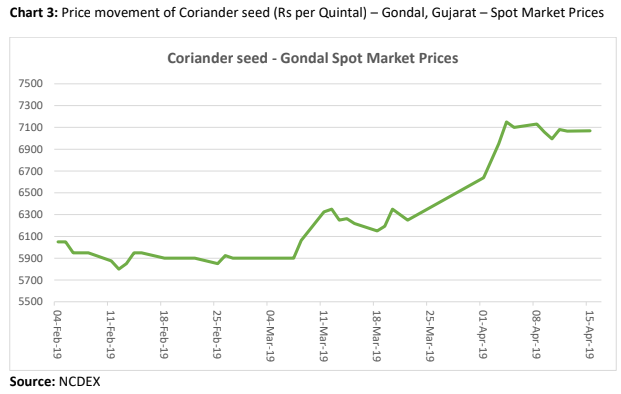
Market commentary: Price outlook
- Overall expectations of Coriander Seed prices to go up in the immediate/short term period.
- Market sentiments have been bullish in major markets like Kota, Gondal and Ramganj during this month.
- Physical Spot market prices which were at levels of Rs. 6,800 to 7,000 per quintal at Kota are expected to cross the Rs. 7,300 per quintal mark.


Your look is very unique compared to other folks I have read stuff from.
Thanks for posting in case you have the chance, Guess I am
going to just book mark this website.
Feel free to surf to my blog; DougMVillani
I’d love to be grateful for the efforts you possess place in scripting this
website. I’m hoping to find out a similar high-grade blog
articles by you down the road as well. In reality, your creative writing abilities has inspired me to obtain my very own blog now 😉
My blog post – AmeeIShiel
bookmarked!!, I really like your blog!|
Hey! I could possibly have sworn I’ve gone to this site before but after reading through a few of the post I
realized it’s a novice to me. Nonetheless, I’m definitely delighted I discovered
it and I’ll be book-marking and checking back often!
my website: InaZWillimon
Hello there, I found your site by way of Google even as looking for a related subject, your web site came up,
it seems to be great. I’ve bookmarked it in my google bookmarks.
Hi there, simply was alert to your blog through Google, and found that it’s truly
informative. I am going to watch out for brussels.
I will be grateful if you happen to proceed this in future.
Numerous folks can be benefited from your writing. Cheers!
I’m really inspired along with your writing abilities and also with the format for your blog.
Is this a paid subject matter or did you modify it yourself?
Either way stay up the excellent high quality writing, it’s rare to peer
a great weblog like this one these days..
Greetings I am so grateful I found your site, I really found you by error, while I was searching on Yahoo for something else, Anyways I
am here now and would just like to say kudos for a marvelous post and a all round enjoyable blog (I
also love the theme/design), I don’t have time to look over it all at the minute but I have book-marked it and also added in your RSS feeds, so when I have
time I will be back to read more, Please do keep up the
awesome work.
Hello, after reading this amazing piece of writing i am also
cheerful to share my familiarity here with mates.
I am regular reader, how are you everybody?
This paragraph posted at this web page is in fact nice.
My brother suggested I might like this website. He used to
be totally right. This post actually made my day. You cann’t imagine just how much time I had spent for this information! Thank you!
Heya i’m for the first time here. I came across this board and I find It really useful & it helped me out much.
I hope to give something back and aid others like you
aided me.
If some one wishes to be updated with newest technologies after that he must be pay
a quick visit this site and be up to date daily.
I got this site from my pal who shared with me concerning this web site
and now this time I am browsing this website and reading very
informative posts here.